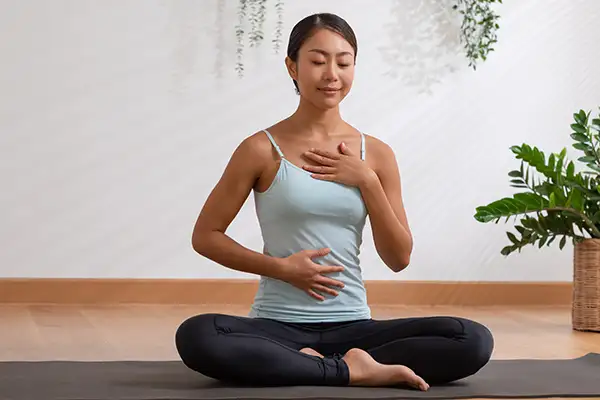
You know that feeling when your brain won't stop. Not one big worry, exactly, just a constant low hum of everything you haven't done, should have done, or might need to deal with tomorrow. It's exhausting. And it makes it hard to be present for anything, including the people who matter most to you.
In my twenty-plus years as a therapist, mindfulness is one of the tools I come back to most often with clients. And you don't need a meditation retreat or an hour of silence to start feeling different. What we're really talking about with mindfulness is something much simpler: noticing what's happening inside you without immediately reacting to it.
Many people I work with are surprised to learn they're already doing a version of this. That moment when you catch yourself spiraling about tomorrow's meeting and think, "Okay, I'm doing it again." That's awareness. These exercises just help us get better at it on purpose.
Start with your breath (seriously)
Deep breathing sounds basic, and people sometimes roll their eyes when it comes up. But here's the thing: breathing is the one body function that's both automatic and voluntary, which makes it a kind of doorway between our conscious mind and our nervous system. When we slow our exhale, we're telling our body it's safe.
Try this 2-minute reset:
- Inhale: Breathe in through your nose for a count of four, feeling your ribs expand.
- The long exhale: Breathe out through your mouth for a count of six or seven. That longer exhale is what activates the parasympathetic nervous system.
- When your mind wanders: And it will, within seconds. Just notice the thought and come back to the breath. No judgment.
Two minutes of this can shift things. Some people do it in the car before walking into the office. Others use it in the bathroom at a family gathering. It doesn't need to be a whole production.
When you carry stress in your body without realizing it
Some of us don't even notice how tense we are until someone points it out. Clenched jaw all afternoon. Shoulders up by the ears. Headaches that seem to come from nowhere. Progressive muscle relaxation helps with this because it teaches the body to recognize what tension actually feels like so we can catch it earlier.
The technique:
- Isolate and tense: Starting at your feet, squeeze a muscle group as tight as you can for five seconds.
- The release: Drop the tension instantly and notice the sensation of the muscle becoming heavy and loose.
- Work upwards: Move from calves to thighs, stomach, hands, shoulders, and finally your jaw.
What makes this different from just "relaxing" is that the deliberate tensing gives the brain a contrast. Over time we get better at spotting tension before it builds into a headache or a stiff neck.
Meditation as the longer game
Meditation is where most people think mindfulness starts, but it actually works better once the shorter exercises feel natural. Sitting with your eyes closed and focusing on your breath or a single word, and then gently redirecting your attention every time your mind wanders, that's a real skill, and it takes patience.
It's worth knowing this: the moment you notice your mind has wandered IS the practice. You didn't fail because you started thinking about dinner. You succeeded because you caught it. That catching-and-returning motion is what builds the mental muscle over time. There's more about building habits like this in our piece on setting mental health goals.
Mindfulness isn't a replacement for therapy when something deeper is going on. But as a daily practice, it gives us a little more space between what happens to us and how we respond. That space changes things. We talk about some related strategies in our article on managing anxiety, if you'd like to read more.
None of this requires perfection. It requires showing up for a few minutes at a time, over and over, and being patient with a mind that wanders. That's not a flaw in the process. That is the process. And for people dealing with anxiety or stress that feels like it never lets up, even small shifts in awareness can make daily life feel more manageable.
In person and virtual sessions available
If stress or anxiety is getting in the way of your daily life and you want to talk it through, I'm here. You can fill out the contact form below or call me at 818-403-5439. I see clients in person at my Agoura Hills office and virtually anywhere in California, including Westlake Village, Oak Park, Calabasas, Thousand Oaks, Woodland Hills, and Simi Valley.
If you need support right now. If you or someone you know is in crisis or thinking about self-harm, call or text 988 to reach the Suicide & Crisis Lifeline, or text HOME to 741741 for the Crisis Text Line. Both are free and available 24 hours a day. Call 911 if someone is in immediate danger.
This article is for general education and support. It is not medical or mental health advice, diagnosis, or treatment, and reading it does not create a therapist-client relationship. If something here sounds familiar, talking with a licensed therapist can help.
See these articles in your Google feed
Add this site as a preferred source and new posts surface for you first.