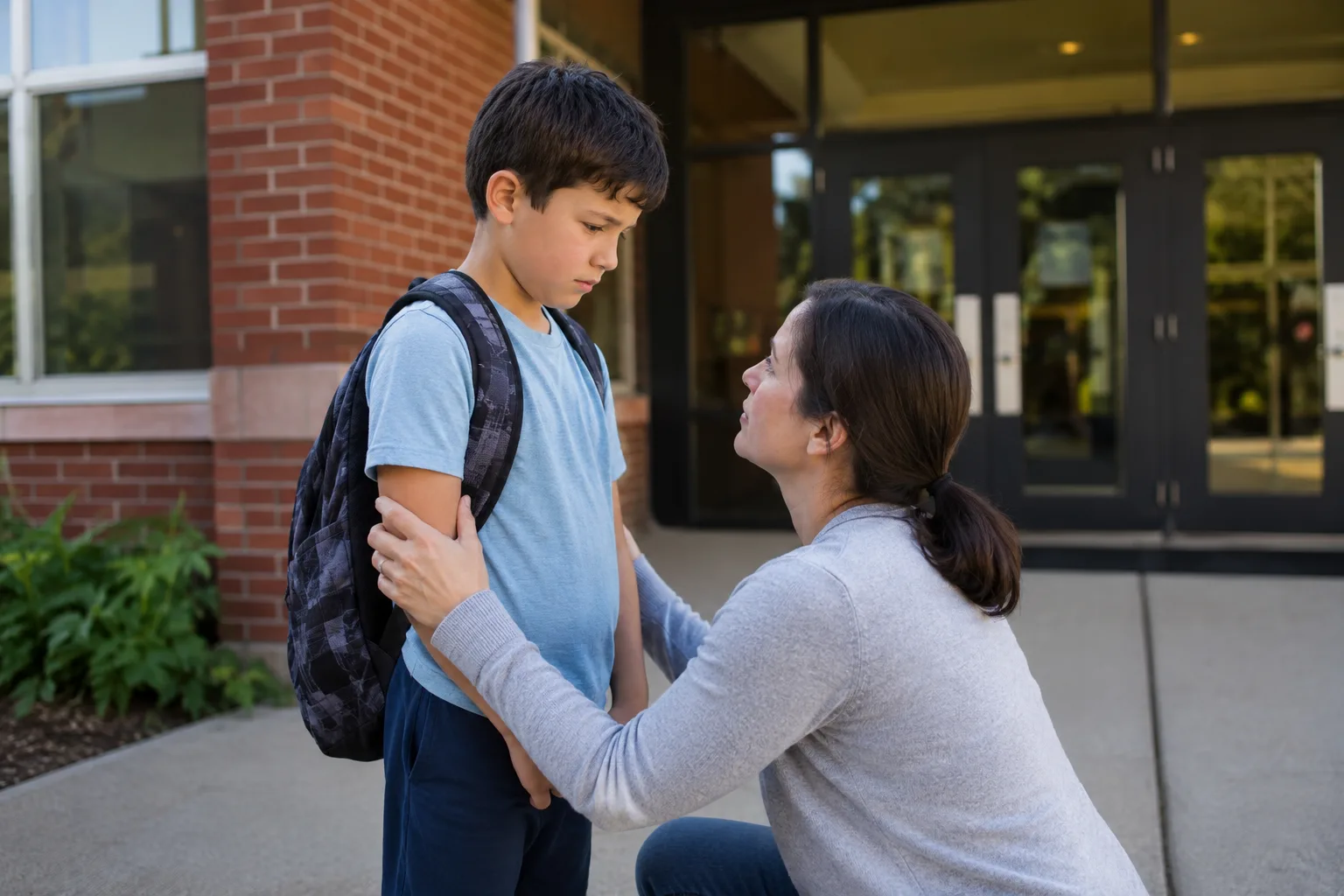
You can feel it the moment your child wakes up. The dread in their eyes, the tightening in your own chest, and that familiar knot in your stomach because you already know what is coming. The tears, the begging, the stomachaches that vanish by noon. Mornings have turned into a battleground, and you are exhausted from fighting it.
In my twenty-plus years as a therapist working with children and families, I have sat across from so many parents who describe this exact scene. They love their kids. They want to do the right thing. But they are stuck between pushing too hard and giving in, and neither option feels like the answer. If that is where you are right now, I want you to know that what your child is going through has a name, it is more common than you think, and there are real ways to help.
School refusal is more common than most parents realize, and it is not about laziness or bad behavior. It is about a child whose emotional distress has gotten so big that going to school feels genuinely impossible.
School refusal is not the same as skipping school
This is an important distinction, because the two look very different and need very different responses.
A child who is truant sneaks away. They leave the house looking like they are headed to school and go somewhere else instead. Their parents often have no idea. Truancy tends to be tied to behavioral issues, lack of interest in academics, or peer influence.
School refusal happens right out in the open. Your child is home, you know about it, and they are usually miserable. Most of these kids actually want to go to school. They just feel like they cannot. The anxiety, panic, or fear they are carrying makes the school building feel like a threat their body is telling them to avoid.
Some children can point to exactly what scares them: being called on in class, eating in the cafeteria, being away from a parent. Others cannot put it into words at all. They just know that something about school feels unbearable.
School refusal can surface at any age, but it tends to peak during transitions: starting kindergarten, moving from elementary to middle school, entering high school. If your child is heading to college rather than back to school, Sending Your Child to College: Anxiety, Homesickness, and the Empty Nest covers that transition. If your child is anxious about the start of the year but still getting out the door, Back-to-School Anxiety: Preparing Your Child covers the earlier stage of this. Big life changes like a family move, a divorce, the death of a loved one, or an illness can trigger it too.
What is usually driving it
There is rarely one single cause. School refusal usually grows from a mix of factors that make the school environment feel overwhelming. Here are the most common ones I see:
- Anxiety: This is the biggest driver. Whether it is generalized anxiety, social anxiety, separation anxiety, or a specific phobia tied to something at school, the fear can produce real physical symptoms like nausea, headaches, racing heart, and difficulty breathing. Your child is not making it up. Their body is genuinely responding to what it perceives as danger.
- Depression: A child struggling with depression may lack the energy or emotional capacity to face a full school day. Getting out of bed can feel monumental when you are already fighting just to get through the day.
- Bullying: If your child is being bullied physically, verbally, or socially, school becomes a place associated with pain and humiliation. Kids who are bullied do not always tell their parents, so school refusal may be your first clue.
- Social fears: Some children are intensely afraid of social situations at school. Group projects, cafeteria lunch, PE class, or anything where they feel exposed or judged. This goes well beyond normal shyness.
- Family changes: Divorce, a new sibling, a parent's illness, a recent move, or a death in the family can shake a child's sense of security. When home life feels uncertain, a child may resist leaving because they are afraid of what might happen while they are gone.
- Academic struggles: A child who is falling behind, who has an undiagnosed learning difference, or who feels set up for failure every day may refuse school because the embarrassment and frustration have become too much.
Warning signs to watch for
School refusal does not always start with a dramatic meltdown at the front door. It often builds gradually. Watch for these patterns:
- Physical complaints with a pattern: Stomachaches, headaches, or nausea on school mornings that disappear on weekends and holidays. The weekend pattern is a useful clue, but it is still worth checking in with your pediatrician to rule out a medical cause
- Stalling and avoidance: Increasing difficulty getting ready, including slow dressing, hiding, or finding reasons to delay
- Frequent nurse visits: Regular trips to the school nurse or requests to come home early
- Emotional distress: Crying, begging, or pleading not to go to school
- Aggressive behavior: Tantrums or outbursts when it is time to leave for school
- Sunday night anxiety: Difficulty falling asleep the night before a school day, or anxiety that ramps up as the weekend ends
- Reassurance-seeking: Asking repeated questions about what will happen at school or needing constant reassurance
- Academic decline: Falling grades or incomplete assignments
- Social withdrawal: Pulling away from friends or dropping extracurricular activities
What tends to make things worse
When your child is refusing school, it is natural to feel frustrated, worried, and unsure. Here are a few approaches that usually backfire:
Dismissing their feelings. Telling a child to "just toughen up" or "stop being dramatic" does not fix the problem and teaches them their emotions are not valid. Their distress is real, even if the reason is not immediately clear to you.
Letting avoidance continue without a plan. It is important to honor your child's feelings, but allowing them to stay home day after day without working toward a solution reinforces the idea that school is something to escape. The longer a child stays out of school, the harder the return becomes.
Punishing the refusal. Taking away privileges or grounding a child for school refusal does not address the root cause. If anxiety or depression is behind the behavior, punishment just adds shame to an already painful situation.
Making home too comfortable on school days. If your child stays home, the day should be quiet and structured rather than a day of video games and screen time. The goal is not to make home miserable, but to avoid creating reasons to stay.
What actually helps
Getting through school refusal takes patience, consistency, and teamwork. Here are steps that make a real difference:
- Acknowledge feelings without giving in to avoidance: Try something like, "I can see that you are really worried about going to school today. That must feel awful. But I also know that staying home is going to make it harder to go back tomorrow. Let's figure this out together."
- Ask better questions: Instead of "Is everything okay at school?" try "What is the hardest part of your school day?" or "If you could change one thing about school, what would it be?" Sometimes the real issue is not what you expect.
- Build a consistent morning routine: Predictability helps reduce anxiety. A clear, calm routine with built-in time for each step can make mornings feel less chaotic.
- Partner with the school: Contact your child's teacher, school counselor, or administrator. They may be able to offer accommodations like a later start time, a check-in person at the entrance, a modified schedule, or a quiet place your child can go when feeling overwhelmed. Schools deal with this more often than you might think.
- Create a gradual re-entry plan: If your child has been out for a while, jumping back into a full day may be too much. Work with the school and a therapist to build a step-by-step plan, maybe starting with an hour, then a half day, then a full day, gradually building tolerance and confidence.
When it is more than school avoidance. School refusal sometimes sits alongside deeper distress. If your child talks about not wanting to be here, about hurting themselves, or about life not being worth it, treat that as urgent rather than waiting for an appointment. Call or text 988 for the Suicide & Crisis Lifeline, or text HOME to 741741. Call 911 if your child is in immediate danger. If your child tells you something is happening at school that is frightening or unsafe, that is worth acting on right away too.
How therapy helps
Therapy is often a good fit for school refusal, and it can help on several levels at once.
A therapist can help uncover what is actually driving the refusal, whether that is anxiety, depression, a social difficulty, or trauma that the child may not have the words for yet. From there, we teach children concrete, practical skills like deep breathing, cognitive restructuring, and problem solving that they can use in the moment when they feel overwhelmed.
We also work with kids to face their fears in small, manageable steps, building confidence over time rather than expecting them to power through all at once. And family therapy can help parents learn how to respond in ways that are supportive without accidentally reinforcing avoidance.
What about the attendance letters
One thing that catches parents off guard: even though school refusal is driven by anxiety rather than defiance, school attendance rules still apply. Missed days accumulate the same way, and families sometimes receive truancy notices in the middle of an already difficult stretch.
Getting ahead of it helps. Let the school know early what is going on rather than waiting for the letters to arrive. Ask what documentation they need, whether a note from a therapist or physician changes how absences are recorded, and what support plans exist for students with anxiety-related attendance problems. What is available varies quite a bit between schools and districts, so it is worth asking directly rather than assuming.
Frequently asked questions
What is the difference between school refusal and truancy?
School refusal is driven by emotional distress such as anxiety, depression, or fear, and the child typically stays home with the parent's knowledge. Truancy involves a child skipping school without parental awareness, often without the same level of emotional distress. Children who refuse school usually want to attend but feel unable to, while truant children are typically avoiding school for other reasons.
How long does school refusal typically last?
Without intervention, school refusal can persist for weeks, months, or even an entire school year. The longer a child stays out of school, the harder it becomes to return. Early intervention is important because children who receive support quickly tend to return to school faster and with less distress.
Should I force my child to go to school if they are refusing?
Simply forcing a distressed child to attend school without addressing the underlying cause rarely works and can make the problem worse. However, allowing a child to stay home indefinitely is also not the answer. The most effective approach is to work with a therapist and the school to create a gradual re-entry plan while addressing the emotional issues driving the refusal.
Can therapy help with school refusal?
Yes, therapy is frequently helpful for school refusal. A therapist can help identify the root cause, teach the child coping skills for managing anxiety or other emotions, work with parents on supportive strategies, and collaborate with the school to create a plan for returning to the classroom.
Is some resistance to school normal, or is this always a problem?
Plenty of children grumble about school, drag their feet on Monday mornings, or have a rough first week after a long break. That is ordinary. School refusal looks different: the distress is bigger, it keeps showing up, and it starts interfering with actually getting to school. If your child is upset but still going, that is worth paying attention to rather than worrying about. If they are regularly not making it in, that is the point to take it seriously.
What should I do if the school starts sending attendance letters?
Reach out to the school before the letters start arriving rather than after. Explain what is going on, ask what documentation they need, and ask whether a note from a therapist or physician changes how the absences are recorded. Ask what support plans they have for students with anxiety-related attendance problems. What is available varies quite a bit between schools and districts, so it is worth asking directly.
If mornings in your house have become a source of dread for the whole family, you do not have to keep white-knuckling your way through it alone. I work with children and families from my office in Agoura Hills and virtually anywhere in California, including Westlake Village, Oak Park, Calabasas, Thousand Oaks, Woodland Hills, and Simi Valley. Together we can figure out what is driving your child's school refusal and build a real plan to help them get back on track. Call me at 818-403-5439 or fill out the contact form below to set up a consultation.
If you need support right now. If you or someone you know is in crisis or thinking about self-harm, call or text 988 to reach the Suicide & Crisis Lifeline, or text HOME to 741741 for the Crisis Text Line. Both are free and available 24 hours a day. Call 911 if someone is in immediate danger.
This article is for general education and support. It is not medical or mental health advice, diagnosis, or treatment, and reading it does not create a therapist-client relationship. If something here sounds familiar, talking with a licensed therapist can help.

See these articles in your Google feed
Add this site as a preferred source and new posts surface for you first.